


Most online businesses already have systems in place for their storefront, inventory, customer data, orders, and marketing. They may use an eCommerce platform, CRM, ERP system, or even spreadsheets to manage different parts of the business. When businesses hear about AI-powered eCommerce, they may assume that all of these systems need to be replaced.
That is not necessarily the case. AI can often be added to existing workflows to handle specific tasks, analyse data, and reduce repetitive manual work. Instead of replacing the entire eCommerce operation, businesses can use AI where it can solve a particular problem or improve an existing process.
This article explains how AI-powered eCommerce systems can work with existing business workflows and where they can provide practical value.
What Are AI-Powered eCommerce Systems?
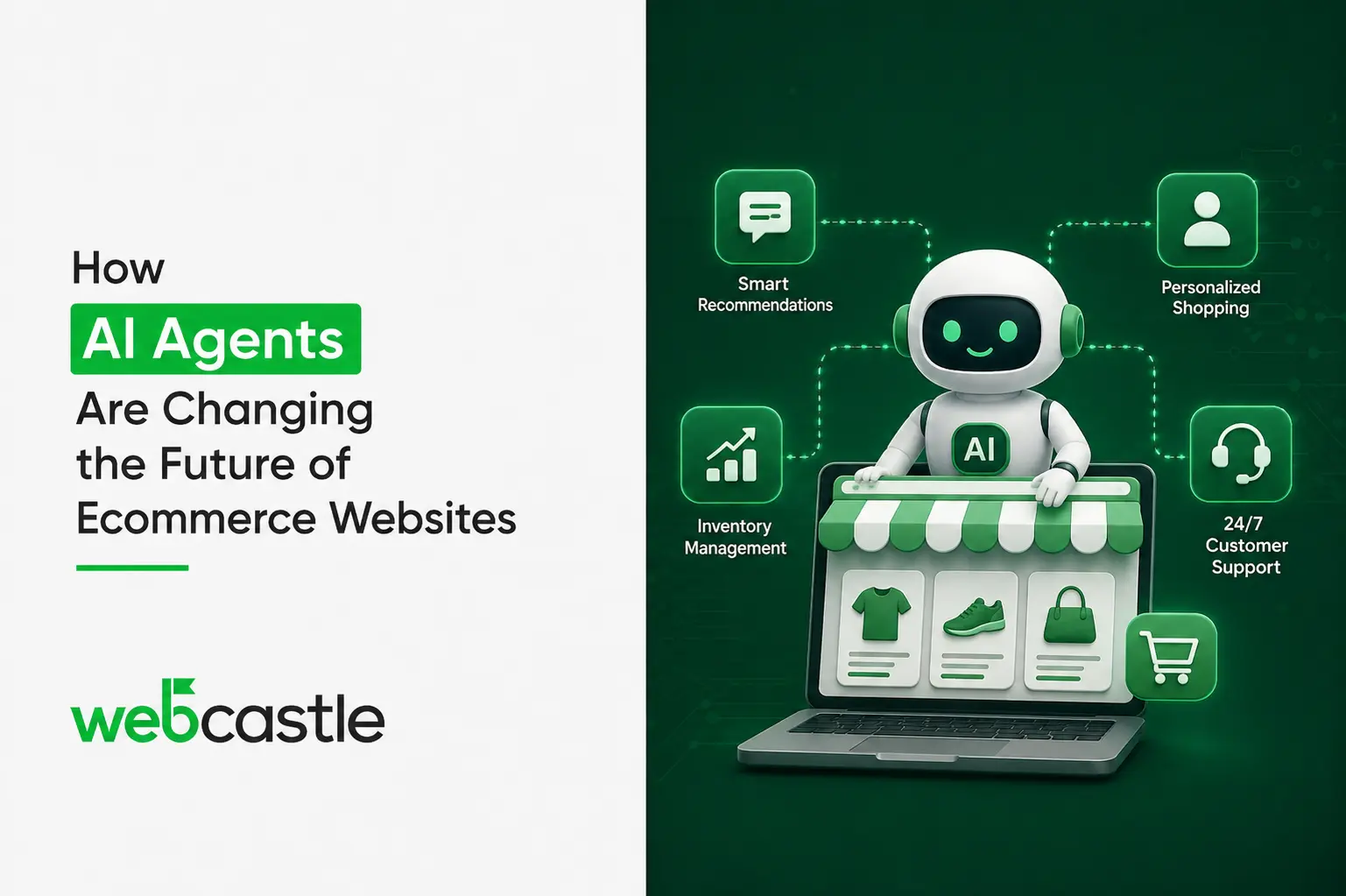
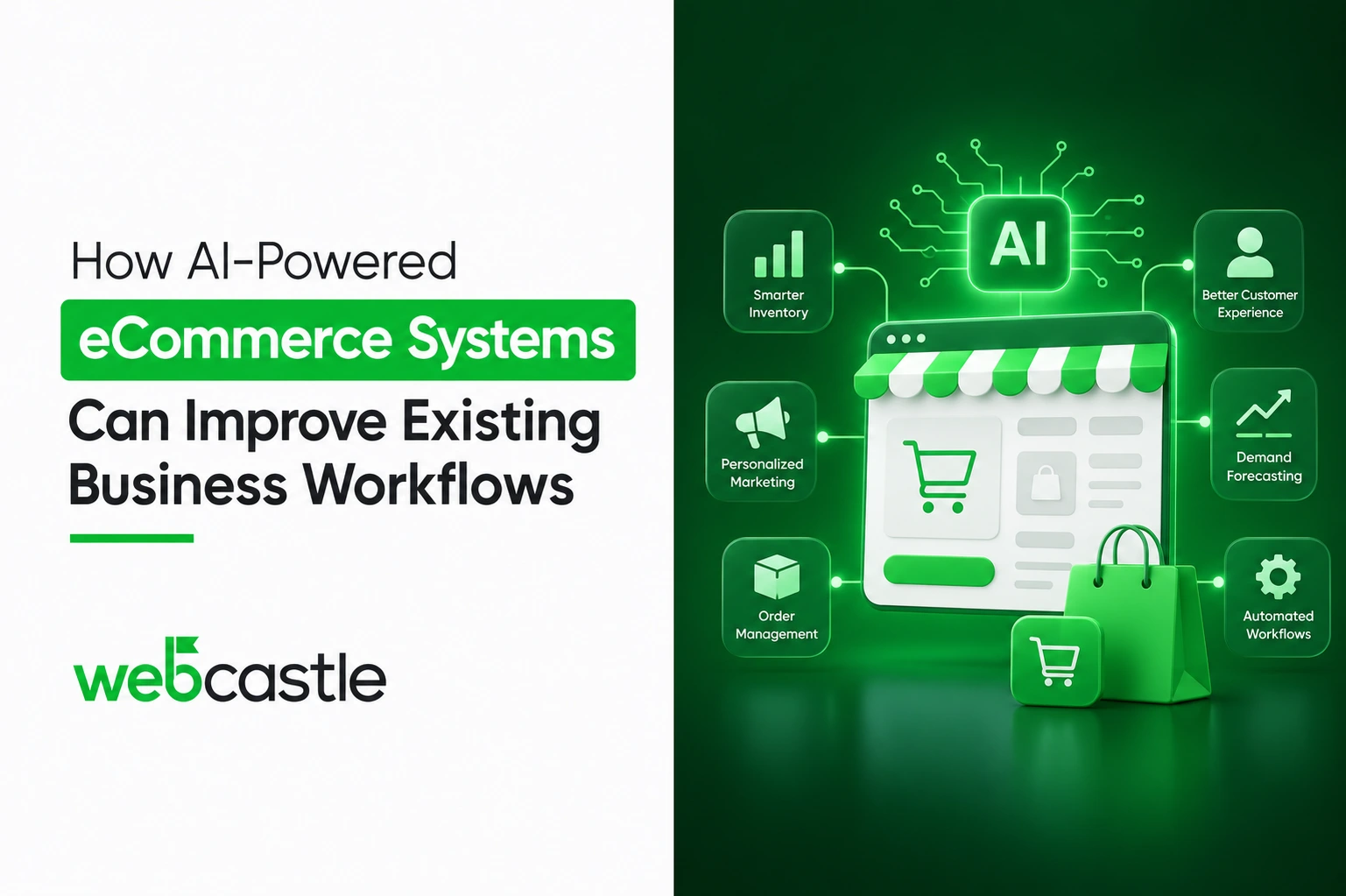
An AI-powered eCommerce system uses artificial intelligence or machine learning to perform tasks that would otherwise require manual work or fixed rules. Common examples include product recommendations, customer support tools, demand forecasting, product search, and fraud detection.
These tools can work alongside existing eCommerce platforms such as Shopify, WooCommerce, Magento, or custom-built stores. They can also connect with CRM, ERP, inventory, and marketing systems through APIs or other integrations.
For example, an AI recommendation system can use customer activity and product information to suggest relevant products on an existing online store. The store itself does not necessarily need to be replaced. Instead, AI becomes an additional capability within the existing setup.
Why Businesses Are Adding AI to Existing eCommerce Workflows
Businesses often consider AI because they have a specific workflow problem rather than simply because they want to use new technology.
Common challenges include:
- Repetitive tasks such as updating product information or answering common questions
- Large amounts of customer and product data that are difficult to analyse manually
- Slow responses to routine customer queries
- Manual inventory and order management
- Difficulty identifying customer preferences and buying patterns
- Time-consuming reporting and data analysis
- Repetitive marketing and customer segmentation tasks
AI can help automate or support some of these processes. However, the right solution depends on the business, its existing systems, the quality of its data, and the particular workflow being improved.
How AI Can Improve Existing eCommerce Workflows
Automated Customer Support
Customer support teams often spend significant time answering repetitive questions about delivery, returns, product availability, and other common topics.
AI-powered chatbots and support tools can handle suitable routine questions and direct more complex issues to human agents. This can help customers get faster responses while allowing support teams to focus on situations that require human judgment.
Product Recommendations and Personalisation
AI can analyse customer interactions and product data to provide more relevant recommendations. Depending on the system, recommendations may use information such as browsing activity, previous purchases, or similar product interactions.
For example, a customer who purchases running shoes may receive recommendations for related products such as socks or insoles.
The benefit is not that AI guarantees more sales, but that it can help businesses present more relevant products to shoppers.
Demand Forecasting and Inventory Planning
Inventory decisions are often based on historical sales data and manual analysis. AI-powered forecasting tools can analyse sales patterns and other relevant signals to estimate future demand.
This can help businesses plan stock levels and prepare for seasonal changes. However, forecasting accuracy depends on the quality and relevance of the data being used.
Product Categorisation and Content
Large eCommerce stores may need to add hundreds or thousands of products. AI can help suggest product categories, attributes, or initial descriptions based on available product information.
A human review is still important, particularly for product specifications, pricing information, claims, and other details that need to be accurate.
Customer Segmentation and Marketing
AI can help analyse customer behaviour and identify groups based on factors such as purchase history, product interests, or purchase frequency.
For example, a business could create different campaigns for regular customers and customers who have not purchased recently. This can make marketing communication more relevant without requiring every customer segment to be created manually.
Sales Reporting and Business Insights
Business reporting can involve collecting information from several systems and preparing it for review. AI-supported analytics tools can help identify patterns, trends, or unusual changes in business data.
This can reduce some of the manual work involved in preparing reports and allow teams to spend more time interpreting the information and making decisions.
Fraud Detection
AI and machine learning can also be used to identify potentially unusual or fraudulent transactions. These systems can analyse transaction patterns and flag activity for further review.
The purpose is not to let AI make every decision independently. In many cases, flagged transactions still require human review, especially when the consequences of a false alert are significant.
AI Does Not Mean Replacing the Existing eCommerce System
One of the biggest misconceptions about AI-powered eCommerce is that businesses need to rebuild their entire technology infrastructure.
In many cases, AI tools can connect with existing systems through APIs and other integrations. For example, customer or product data can be transferred between an eCommerce platform and an AI service, allowing the AI tool to perform a specific function within the existing workflow.
The exact integration depends on the platform and the AI solution. Some tools offer ready-made integrations, while more complex requirements may need custom development.
This means businesses can often introduce AI gradually instead of changing their entire eCommerce system at once.
Example of an AI-Powered eCommerce Workflow
Consider an online fashion store that wants to improve its existing customer journey.
A customer visits the website and receives relevant product recommendations based on their activity. They then use an AI chatbot to ask about delivery or sizing. After placing an order, the existing eCommerce system processes the purchase, while connected tools can assist with inventory updates, customer notifications, or fraud checks.
After delivery, the business can use customer purchase data to identify suitable follow-up products or marketing opportunities.
The important point is that AI does not have to control the entire process. Different AI capabilities can be added to specific stages of an existing workflow.
Benefits of AI-Powered eCommerce Workflows
AI can help eCommerce businesses improve daily processes,
customer experiences, and decision-making.
⚙ Reduce Manual Work
Automate repetitive tasks and save valuable team time.
💬 Faster Responses
Improve response times for routine customer queries.
🎯 Better Recommendations
Provide more relevant product recommendations to customers.
📦 Smarter Inventory Planning
Support inventory and demand planning using business data.
👥 Efficient Segmentation
Make customer segmentation more efficient for marketing.
📊 Faster Reporting
Reduce the time spent preparing routine business reports.
🧠 Better Use of Data
Help teams make better use of existing business data.
Important: Results Depend on Implementation
AI benefits are not automatic. Results depend on data quality,
integration, implementation, and how well the AI solution matches
the business process.
What Businesses Should Consider Before Implementing AI
Before introducing AI, businesses should look at the workflow they want to improve rather than trying to automate everything.
Important considerations include:
- Existing systems: Check whether the current platform supports the required integration.
- Data quality: Incomplete or inconsistent data can limit the usefulness of AI.
- Privacy and security: Customer and business data should be handled appropriately.
- Cost: Consider software, integration, development, and ongoing maintenance costs.
- Human oversight: AI-generated content and AI-supported decisions may still require human review.
- Measurement: Define what improvement will be measured before implementation.
- Use case: Start with a specific problem where automation or analysis can provide a clear benefit.
How to Start Using AI in an Existing eCommerce Workflow
A practical approach is to start small.
First, identify repetitive or time-consuming tasks in the current workflow. Next, select one or two suitable use cases and check whether the existing systems and data can support them.
The chosen AI solution can then be integrated into the existing process and tested on a smaller scale. Businesses should monitor the results, compare them with the previous workflow, and make adjustments where necessary.
Once one use case is working effectively, other suitable workflows can be considered.
AI and eCommerce Solutions for Business Workflows
Businesses looking to implement AI-powered eCommerce workflows can work with an experienced technology partner to plan, develop, and integrate the right solutions.
WebCastle Technologies provides eCommerce development and AI solutions for areas such as workflow automation, customer support, product recommendations, data analysis, and reporting. As a best ecommerce development company in Dubai, WebCastle Technologies can help businesses build scalable eCommerce platforms, while its AI expertise supports businesses exploring solutions offered by the top AI companies in Dubai.
The focus is on selecting AI applications that fit the business process, existing technology, and customer needs.
Conclusion
AI-powered eCommerce does not have to mean replacing everything a business already uses. In many cases, AI is most useful when it is introduced into specific parts of an existing workflow, such as customer support, product recommendations, forecasting, reporting, or fraud detection.
The most practical approach is to identify a clear business problem, choose an appropriate AI solution, test it within the existing workflow, and measure the results. Rather than adopting AI simply for the sake of new technology, businesses can use it where it provides a meaningful improvement to everyday eCommerce operations.